
Herb
Du Huo
独活
AI editorial reviewAI evidence and editorial review by Codex. Human clinical review pending. Educational reference, not an individual prescription. Review policy
Du Huo is the root of Angelica pubescens f. biserrata, used in traditional practice to dispel wind-dampness and relieve painful obstruction, especially in the lower back and knees.
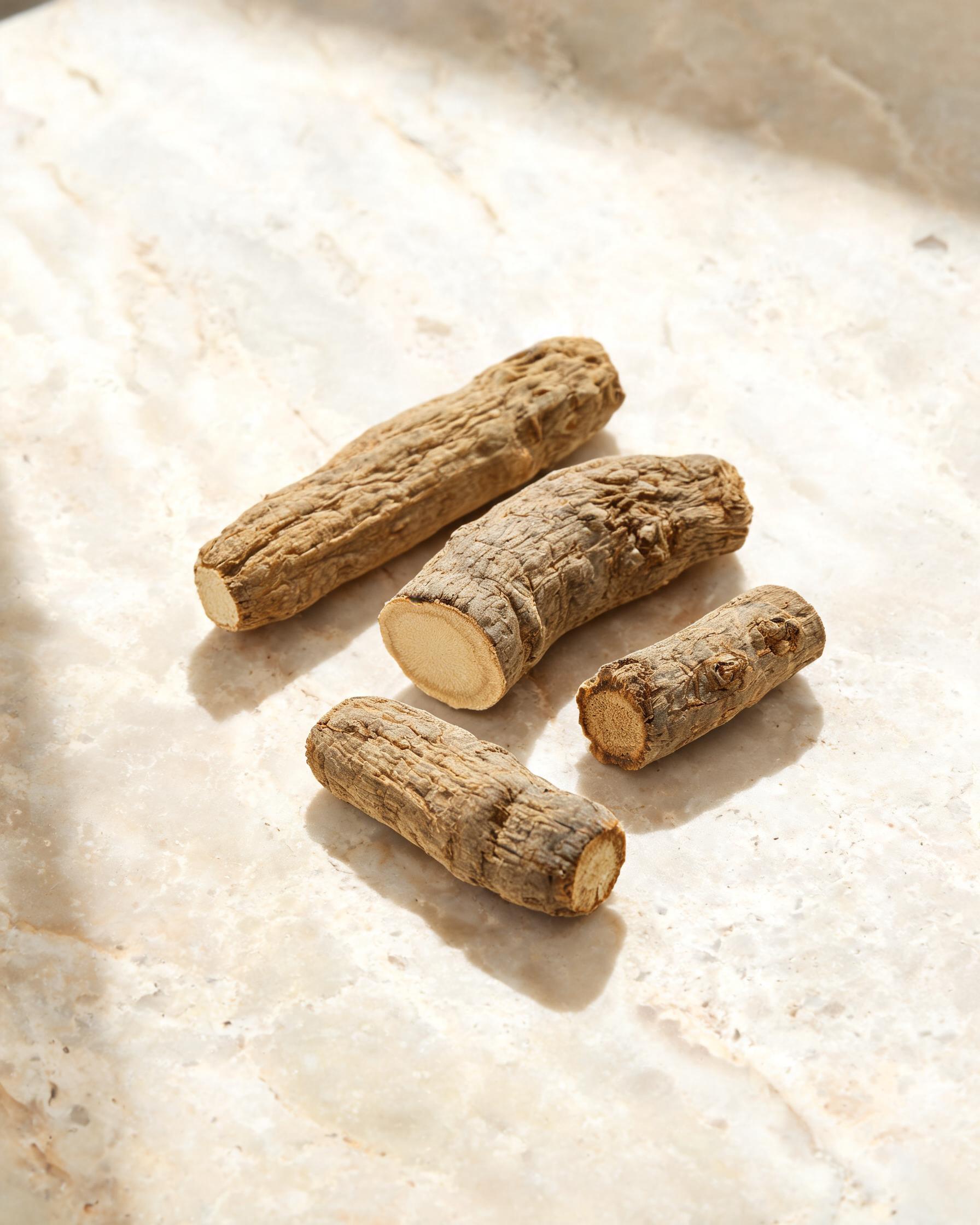
- Botanical name
- Angelica pubescens f. biserrata
- Part used
- Dried root
- Properties
- Acrid, bitter; slightly warm. Channels: Kidney, Bladder
- Dose
- 3 to 10 g (CP 2020); 3 to 11.5 g (THP)
On this page
Not appraised
Codex preliminary evidence and safety review; no human clinical sign-off or herb-alone knee efficacy approval.
Identity and species
Du Huo is the dried root of Angelica pubescens Maxim. f. biserrata Shan et Yuan, a perennial herb of the Apiaceae [1]. The root is cylindrical, often branched below, 10 to 30 cm long, with a swollen conical root head, grey-brown to brown bark, longitudinal wrinkles and scattered brown oil cavities [1]. The pharmacopoeia requires not less than 0.50 per cent osthole and 0.080 per cent columbianadin [1].
The materia medica names the same source and notes that Qiang Huo was confused with Du Huo until the Song and Yuan dynasties [3]. The two are different drugs and should not be substituted by name alone.
Processing and forms
The root is collected in early spring as the shoots begin to emerge or in late autumn after the stems wither. Rootlets and soil are removed, the root is baked until half dry, stacked for two to three days until soft, then baked until fully dry [1]. Decoction pieces are cleaned, washed, softened, cut into thin slices and dried in the sun or at low temperature [1].
The dried root is stored in a dry place, protected from mould and insects [1]. The materia medica describes thin slices and notes that roots with a rich aromatic fragrance are preferred [3].
Actions
Du Huo dispels wind-dampness and relieves painful obstruction [1]. The materia medica adds that it releases the exterior [3]. These are traditional action categories, not demonstrated clinical effects.
Its traditional character is acrid, bitter and slightly warm, with an affinity for the Kidney and Bladder channels [1]. It is described as acting more on the interior and lower part of the body than Qiang Huo, and as suitable for wind-cold-dampness that has settled in the lower back and knees [3].
General applications
The official indications are wind-cold-damp painful obstruction, pain in the lower back and knees, headache from latent wind in the shaoyin, and headache from wind-cold with dampness [1]. The materia medica groups these as wind-cold-damp arthralgia affecting the lower body, and exterior wind-cold or wind-cold-damp with headache [3].
A suddenly painful, hot or swollen joint needs urgent medical assessment because joint infection is a possible cause [5]. Back or leg pain with new bladder or bowel dysfunction, saddle-area numbness or worsening leg weakness requires emergency assessment [6]. These symptoms should not be managed by trying Du Huo.
Combinations
The materia medica describes Du Huo with Sang Ji Sheng, Du Zhong and Fang Feng in Du Huo Ji Sheng Tang for cold arthralgia with lower back and knee pain, limb weakness and numbness on a background of Kidney deficiency [3]. It also describes Du Huo with Qiang Huo, Jing Jie and Fang Feng in Jing Fang Bai Du San for exterior wind-cold with dampness and headache [3].
These are formula contexts, not evidence that Du Huo alone treats knee osteoarthritis. Formula composition and trial evidence are recorded on the formula pages.
Sources: [3]
Safety
The materia medica cautions against Du Huo in Qi, Yin or Blood deficiency because of its dispersing and drying properties [3]. The same entry describes its use within Du Huo Ji Sheng Tang for cold painful obstruction with Kidney deficiency. These source descriptions do not establish when an individual can safely use the herb or formula; selection requires qualified assessment [3].
The 2020 review describes platelet effects and animal toxicity findings. These do not establish a human interaction or safe exposure threshold [4]. People taking anticoagulant or antiplatelet medicines should seek a medication review before use. The presence of coumarins alone is not proof of a clinical interaction.
Evidence
A 2020 review reports that Du Huo extracts and isolated compounds show analgesic and anti-inflammatory activity in laboratory and animal studies, with additional central nervous system, cardiovascular and deworming activity [4]. It also states that pharmacology and toxicology need further study for clinical use and quality control [4].
No clinical trial of Du Huo alone in knee osteoarthritis was reviewed. The review describes the herb as traditionally used for rheumatic pain of the lower back and knees, but that is a traditional indication, not a clinical trial result [4].
The review combines research on two botanical sources and different extracts or isolated compounds. Its findings cannot all be transferred to the selected medicinal root or a household decoction [4].
Sources: [4]
Dose and forms
The Chinese Pharmacopoeia 2020 states 3 to 10 g in decoction [1]. The Taiwan Herbal Pharmacopoeia states 3 to 11.5 g [2]. Both are reference ranges for the dried root, not a formula amount or an individual prescription.
Use in knee osteoarthritis
Du Huo is the herb named in Du Huo Ji Sheng Tang, a formula described in the materia medica for chronic cold arthralgia with lower back and knee pain on a background of Kidney deficiency [3]. The formula page records its composition and trial evidence. Those results are not attributed here to Du Huo alone.
Sources: [3]
Common questions
Is Du Huo the same as Dang Gui?
No. Both belong to the genus Angelica, but Du Huo is Angelica pubescens f. biserrata and Dang Gui is Angelica sinensis. They are different medicinal materials.
Does Du Huo treat knee osteoarthritis?
The sources reviewed did not include a clinical trial of Du Huo alone in knee osteoarthritis. Formula evidence is not attributed to the herb alone.
Can it be taken with blood-thinning medicine?
The reviewed material does not establish a clinical interaction. Experimental platelet findings justify a medication review before use, rather than assuming either compatibility or a proven interaction.
Why are two dose ranges given?
The Chinese Pharmacopoeia states 3 to 10 g and the Taiwan Herbal Pharmacopoeia states 3 to 11.5 g. Both are reference ranges, not a target for self-treatment.
Sources
- [1] Chinese Pharmacopoeia 2020, Part I, Angelicae Pubescentis Radix
- [2] Taiwan Herbal Pharmacopoeia, 4th edition, English version
- [3] Chang ZF, Jia DX, Bare J, eds. Chinese Materia Medica. International Standard Library of Chinese Medicine. Beijing: People's Medical Publishing House; 2014. ISBN 978-7-117-19647-5
- [4] Lu Y, Wu H, Yu X, et al. Traditional Chinese medicine of Angelicae Pubescentis Radix: a review of phytochemistry, pharmacology and pharmacokinetics. Front Pharmacol 2020;11:335
- [5] NHS. Septic arthritis
- [6] Royal Free London NHS Foundation Trust. Cauda equina syndrome. Patient leaflet RFL1148, approved 22 January 2025